The module completes the fundamentals of technical Thermodynamics taught in the module "Thermodynamics I/Chemistry" by applying the main theorems of Thermodynamics to various energy conversion processes. In particular, sustainable energy conversion processes such as the fuel cell are emphasized.
Through the laboratory, competencies are acquired in the practical handling of energy converters on a laboratory scale, as well as social competence is promoted through group work.
After successful completion of this module, students will be able to
- describe different paths for the conversion of primary energy into useful energy,
- quantitatively balance and evaluate various technically relevant energy converters such as combustion systems, fuel cells, gas turbine plants and steam power plants,
- describe the environmental problems caused by burning fossil fuels and identify solutions,
- to extend the evaluation of the transformability of energy forms by the exergy concept.
Content
- Fundamentals of energy conversion
- Combustion fundamentals
- Fuel Cell Technology
- Steam cycle and power plant processes
- The Stirling Process
- Flow and work processes
- Exergy and anergy
- Heat pumps and refrigeration machines
- Air conditioning / moist air
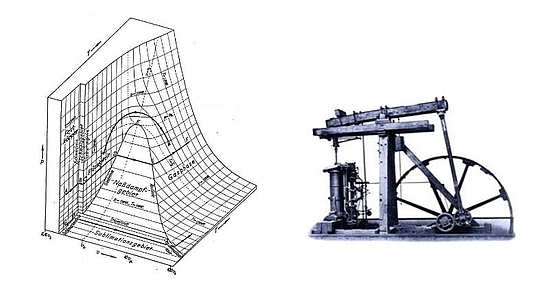 ©
IfT, Leibniz Universität Hannover
©
IfT, Leibniz Universität Hannover
Lecturer


Prof. Dr.-Ing. Stephan Kabelac
Phone
Address
An der Universität 1
30823 Garbsen
30823 Garbsen
Building
Room
Prof. Dr.-Ing. Stephan Kabelac
Phone